

Choosing a qualified Real Estate Appraiser in Israel is an important decision for property buyers, sellers, investors, and foreign residents who own or intend to purchase real estate in the country.
Although Israel is geographically small, its property market is remarkably diverse. Land values, development opportunities, planning restrictions, and local demand can vary significantly between cities, neighborhoods, and even adjacent streets.
A property in central Tel Aviv, for example, may have a substantially different value from a similar property in a peripheral city. Even within the same neighborhood, differences in building rights, accessibility, preservation restrictions, and redevelopment potential can significantly affect market value.
In Israel, real estate appraisers are licensed by the Ministry of Justice. However, holding a professional license does not necessarily mean that every appraiser has the same experience or specializes in the same fields.
Some appraisers primarily value residential apartments, while others possess extensive experience in complex matters such as real estate taxation, development rights, expropriations, planning-related compensation claims, and property disputes.
This guide explains what to look for when selecting a real estate appraiser in Israel and why local market knowledge and specialized professional expertise are essential.
Table of contents [Close]
- What Qualifications and Expertise Should a Real Estate Appraiser Have?
- Why Local Market Knowledge Is Essential in Israeli Property Valuation
- Real Estate Appraisal in Tel Aviv and Central Israel
- Real Estate Appraisal in Haifa and Northern Israel
- Real Estate Appraisal in Jerusalem
- Why Knowledge of Israeli Real Estate Taxation Matters
- Betterment Levy: The Cost of Additional Building Rights
- Example of betterment levy on an additional floor:
- Example of betterment levy on a basement addition:
- Deferred Development Rights and Their Economic Value
- Real Estate Appreciation Tax in Israel
- Understanding Linear Capital Gains Tax in Israel
- Payments to the Israel Land Authority
- Purchase Tax for Property Buyers in Israel
- How to Evaluate a Real Estate Appraiser Before Hiring
- Conclusion: Choosing the Right Real Estate Appraiser in Israel
What Qualifications and Expertise Should a Real Estate Appraiser Have?
A professional real estate appraiser must understand far more than property prices.
Accurate valuation requires knowledge of the local real estate market, statutory planning, building regulations, property rights, and the economic factors influencing supply and demand.
In complex cases, the appraiser must also understand real estate taxation, land lease agreements, development costs, and the financial implications of planning decisions.
For example, two properties with similar physical characteristics may have substantially different values because one has additional development rights while the other is subject to preservation restrictions.
An experienced appraiser must identify these differences, determine their economic significance, and reflect them in the valuation.
Professional specialization is equally important. An appraiser who regularly evaluates residential apartments may not necessarily have the experience required to assess industrial properties, development land, or complex taxation disputes.
Before hiring an appraiser, property owners should therefore examine the professional's experience with the specific property type, geographical area, and purpose of the valuation.
Why Local Market Knowledge Is Essential in Israeli Property Valuation
Israel's real estate market cannot be evaluated as a single uniform market.
Property values are generally higher in major employment centers and areas with strong demand, particularly in central Israel. However, substantial differences also exist within individual cities.
An appraiser must understand the characteristics of each local market, including transportation accessibility, employment opportunities, neighborhood development, demographic demand, and future construction plans.
For this reason, selecting an appraiser familiar with the property's location can be just as important as choosing someone with extensive general experience.
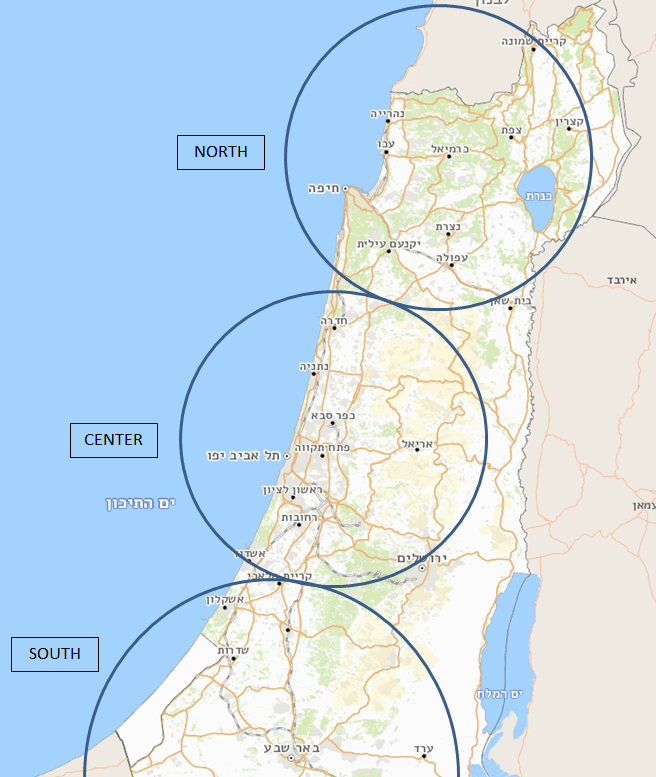
The following examples illustrate how regional expertise affects real estate valuation in Israel.
Map of the division of Israel by regions:
Real Estate Appraisal in Tel Aviv and Central Israel
Central Israel is the country's principal economic and business region, containing major employment centers, commercial districts, and some of the most expensive residential areas.
Cities such as Tel Aviv, Herzliya, Ramat Gan, Givatayim, Rishon LeZion, Petah Tikva, Ra'anana, Kfar Saba, and Netanya form part of this diverse real estate market.
Tel Aviv is particularly complex from a valuation perspective because property values are influenced not only by location and demand but also by preservation regulations, urban redevelopment, and major transportation infrastructure projects.
Historic Building Preservation and Its Effect on Property Value
Tel Aviv contains numerous buildings designated for preservation because of their architectural or historical importance.
Preservation regulations may restrict demolition, alterations, extensions, or the utilization of certain building rights.
A buyer who purchases a historic building based solely on its theoretical development potential may discover that some of the approved rights cannot be realized in the expected manner.
For example, a building may have additional construction rights under an applicable planning scheme, while preservation requirements impose substantial restrictions on how those rights can be exercised.
An experienced real estate appraiser familiar with Tel Aviv's preservation plans can evaluate these restrictions, estimate the costs of complying with preservation requirements, and assess their effect on market value.
This knowledge is especially important when purchasing older buildings for renovation, redevelopment, or investment.
Map of the conservation plan:

How Light Rail and Metro Projects Influence Property Values
Transportation infrastructure is another major factor affecting property values in central Israel.
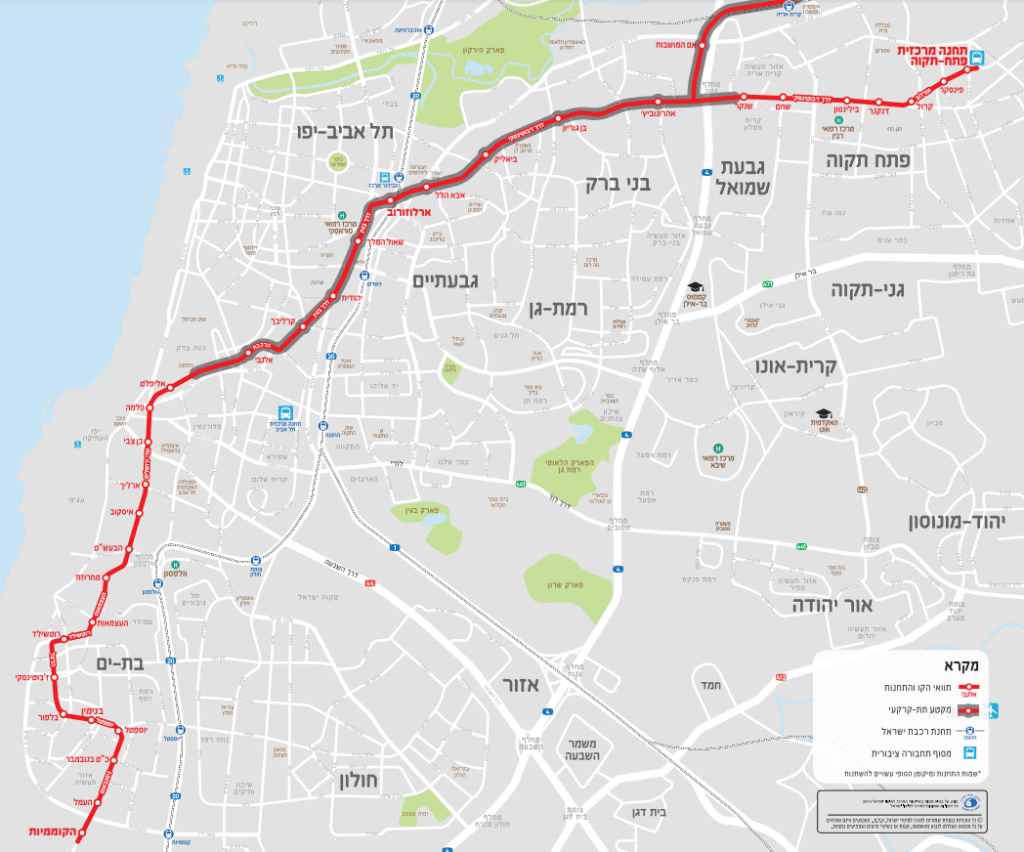
The Tel Aviv metropolitan area is undergoing extensive transportation development, including the operational Red Line of the light rail network, additional light rail lines under development, and planned underground metro lines.
The Red Line is already in operation, connecting Tel Aviv with Bat Yam, Bnei Brak, Petah Tikva, and Ramat Gan. It has improved public transportation accessibility and connectivity between residential neighborhoods, commercial districts, and major employment centers.
Improved public transportation can positively influence property values by increasing accessibility and making nearby properties more attractive to residents, businesses, and investors.
However, the effect on property values is not necessarily uniform. Proximity to an operational station may increase demand, while noise, accessibility limitations, and ongoing construction associated with other transportation projects can affect individual properties differently.
A professional real estate appraiser must therefore distinguish between the existing benefits of operational transportation infrastructure and the potential future benefits of projects that are still under construction or in the planning stages.
Red line map:
The Green Line will connect Tel Aviv with Rishon Lezion, Holon, Bat Yam, Ramat Hasharon, Herzliya, and more.
Green Line Map:

The purple line will connect Tel Aviv with Ramat Gan, Givat Shmuel, Kiryat Ono, Or Yehuda, Yehud, and more.
Purple line map:

In addition to the light rail network, Israel is planning an extensive underground metro system designed to improve connectivity throughout the Tel Aviv metropolitan area.
Part of the map of the metro lines:

Real Estate Appraisal in Haifa and Northern Israel
Haifa is the principal metropolitan center of northern Israel and includes a wide variety of residential neighborhoods, industrial areas, commercial centers, and employment districts.
Property values in Haifa vary significantly according to topography, accessibility, building characteristics, neighborhood demand, and proximity to major transportation routes.
For example, an apartment in a desirable Carmel neighborhood may command a substantially higher price than a comparable apartment in parts of Hadar.
Even within the same neighborhood, sea views, building accessibility, parking availability, and differences in elevation can create substantial valuation differences.
A real estate appraiser operating in Haifa must understand these local characteristics rather than relying exclusively on general price averages.
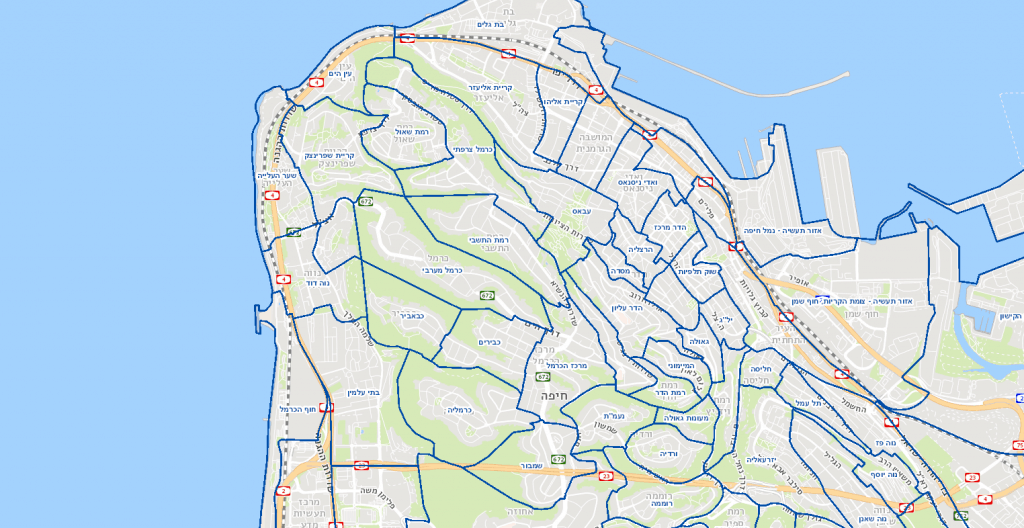
Map of the neighborhoods of Haifa:
Urban Renewal and Additional Building Rights in Haifa
Urban renewal is another important consideration when evaluating older residential buildings in Haifa.
Certain neighborhoods contain buildings that may be suitable for demolition and reconstruction through urban renewal projects, commonly known in Israel as Pinui-Binui.
Under such arrangements, existing apartment owners may receive replacement apartments in newly constructed buildings, while the developer finances the project through the sale of additional units.
The economic potential of these projects depends on approved or anticipated building rights, construction costs, apartment values, planning restrictions, and developer profitability.
Importantly, not every older building is economically or legally suitable for urban renewal.
An experienced appraiser must examine the applicable planning framework and determine whether redevelopment represents a realistic economic opportunity or merely a theoretical possibility.
This distinction can materially affect the valuation of apartments and development sites.
The following is a map of the complexes defined for urban renewal plans:

Real Estate Appraisal in Jerusalem
Jerusalem presents a different set of valuation challenges due to its historical character, diverse neighborhoods, complex planning environment, and extensive preservation considerations.
The city contains residential neighborhoods with distinct characteristics, government institutions, commercial districts, religious centers, and industrial areas.
Property values can vary considerably between neighborhoods because of accessibility, local demand, building types, community characteristics, and development restrictions.
A real estate appraiser in Jerusalem must therefore be familiar with both neighborhood-level market conditions and the planning regulations governing the property.
Below is a diagram of the proposed planning for entering the city:

Planning Schemes and Preservation Restrictions in Jerusalem
Jerusalem has numerous planning schemes that influence building rights, land use, urban renewal, and future development opportunities.
Some areas are subject to preservation requirements intended to protect buildings and sites of historical or architectural importance.
These restrictions can limit redevelopment options or require costly preservation work.
At the same time, planning initiatives in certain parts of Jerusalem may create opportunities for additional construction, commercial development, or urban renewal.
For example, redevelopment around major transportation corridors and the city's entrance district may influence future property demand and development potential.
A professional appraiser must distinguish between approved building rights and proposed planning initiatives whose implementation remains uncertain.
Accurate valuation requires examining the legal planning status of each property rather than assuming that future development proposals will necessarily be realized.
The following is a diagram of the Jerusalem conservation plan:

Why Knowledge of Israeli Real Estate Taxation Matters
Real estate taxation is one of the most complex aspects of property transactions in Israel.
A property owner may face several different financial obligations arising from a sale, a planning approval, or the utilization of additional development rights.
An experienced real estate appraiser can identify valuation-related tax exposures, assess the economic implications of planning changes, and provide professional evidence in disputes concerning property value.
Although tax advice and legal representation may require additional professionals, valuation expertise can play an important role in determining the appropriate financial assessment.
Betterment Levy: The Cost of Additional Building Rights
One of the most significant obligations associated with development rights in Israel is the betterment levy, known as Hetel Hashbacha.
The levy generally arises when certain planning decisions increase the value of real estate. Subject to applicable statutory provisions and exemptions, it is commonly calculated at 50% of the assessed increase in value.
Consider a property containing a 200-square-meter house.
Several years after the property was purchased, a new statutory plan is approved allowing the construction of an additional 100-square-meter floor.
The additional building rights may increase the property's market value, potentially creating a betterment levy liability.
However, the economic value of those rights cannot be determined simply by multiplying the additional floor area by the average value per square meter.
Constructing another floor above an existing occupied building may involve higher construction costs, structural reinforcement, temporary disruption, and additional technical limitations.
A qualified appraiser can analyze these factors and determine how they affect the actual increase in property value.
In certain cases, this professional analysis may support a lower betterment levy assessment than an initial valuation that does not adequately reflect the property's specific circumstances.
Example of betterment levy on an additional floor:
The following example illustrates how a professional real estate appraisal helped reduce the assessed betterment levy by 30%.

Example of betterment levy on a basement addition:
The following example demonstrates how a professional valuation, taking into account the economic limitations and deferred utilization of basement building rights, helped reduce the assessed betterment levy by more than 70%.

Deferred Development Rights and Their Economic Value
Another important issue involves building rights that cannot be utilized economically in the immediate future.
For example, consider a 30-year-old residential building in good condition.
A new planning scheme permits the construction of an additional basement beneath the existing structure.
Although the additional building rights may have theoretical value, constructing a basement beneath an occupied building may be technically difficult or economically unjustified.
The owner may need to wait until the existing building is demolished or substantially redeveloped before the rights can be realized efficiently.
In such circumstances, an experienced real estate appraiser can examine the expected delay, future construction costs, and economic uncertainty associated with utilizing the rights.
Where justified by the applicable valuation framework, these factors may support a reduction in the present economic value attributed to the additional development potential.
This type of analysis can be particularly important in betterment levy assessments and related valuation disputes.
Real Estate Appreciation Tax in Israel
Another major tax consideration is real estate appreciation tax, commonly known as Mas Shevach.
This tax generally applies to taxable gains arising from the sale of real estate rights, subject to applicable exemptions, deductions, adjustments, and special calculation methods.
The taxable gain is not necessarily equal to the simple difference between the original purchase price and the selling price.
Recognized acquisition expenses, qualifying improvements, and other permitted adjustments may affect the final taxable amount.
Different rules may apply depending on the nature of the property, the owner's circumstances, and the relevant acquisition and sale dates.
For certain qualifying residential properties acquired before 2014, a preferential linear calculation may also be relevant.
A real estate appraiser can assist with valuation matters such as documenting property improvements, assessing historical values, and examining the economic contribution of building rights.
These findings may support the work of the legal or taxation professional responsible for calculating the applicable tax.
Understanding Linear Capital Gains Tax in Israel
One important aspect of Israeli real estate taxation is the preferential linear tax calculation, known as Mas Shevach Lineari.
This calculation may apply to qualifying residential apartments purchased before January 1, 2014, particularly when the seller owns more than one apartment and is not entitled to a full capital gains tax exemption.
Under this method, the taxable real gain is divided proportionally according to the ownership period. The portion attributed to the period before January 1, 2014, is generally exempt, while the portion attributed to the period beginning on that date is generally subject to a 25% tax rate.
Example: Selling an Apartment in 2026
Consider a property owner who purchased an apartment on January 1, 1996, for NIS 1,500,000 and sells it on November 7, 2026, for NIS 1,800,000.
The seller owns another apartment and is not entitled to the standard single-apartment exemption.
For this simplified illustration, assume that the taxable real gain, before applying the preferential linear calculation, is NIS 300,000.
The ownership period is divided as follows:
- Total ownership period: 11,268 days.
- Period before January 1, 2014: 6,575 days.
- Period from January 1, 2014, until the sale: 4,693 days.
- Exempt portion of the gain: approximately 58.35%.
- Taxable portion of the gain: approximately 41.65%.
The resulting calculation is:
Taxable gain: NIS 300,000 × 41.65% = approximately NIS 124,947.
Capital gains tax: NIS 124,947 × 25% = approximately NIS 31,237.
Without the preferential linear calculation, applying a 25% tax rate to the entire NIS 300,000 gain would result in a tax liability of NIS 75,000.
In this example, the preferential linear calculation produces a tax difference of approximately NIS 43,763.
The actual tax liability may differ because the taxable real gain must be calculated using the applicable inflation adjustments, recognized expenses, acquisition costs, and other relevant provisions.
A qualified Real Estate Appraiser in Israel can assist in evaluating property improvements, historical values, and additional building rights, providing valuable professional support when determining the economic components of a real estate transaction.
This expertise is particularly important when selling older investment apartments, where a substantial portion of the ownership period precedes January 2014.
Payments to the Israel Land Authority
A substantial portion of Israeli land is administered by the Israel Land Authority (ILA), and many properties are held under long-term leasehold arrangements.
Depending on the lease agreement and applicable regulations, a property owner or lessee may be required to make additional payments when transferring rights, changing land use, or utilizing development rights beyond those covered by the existing agreement.
These payments are distinct from municipal betterment levies and real estate appreciation tax.
For example, a property may have additional building rights under an approved statutory plan, but the lease agreement may not automatically entitle the lessee to utilize all those rights without further payment.
An experienced appraiser can examine the economic implications of these arrangements and assess the potential financial obligations associated with the property.
Identifying such costs before purchasing or developing real estate can prevent unexpected expenses.
Purchase Tax for Property Buyers in Israel
Property buyers in Israel may also be required to pay purchase tax, known as Mas Rechisha.
The applicable tax depends on factors such as the type of property, its purchase price, the buyer's status, and eligibility for relevant tax benefits.
Foreign buyers should pay particular attention to the rules applicable to their circumstances, especially when purchasing residential property.
Purchase tax can represent a significant additional acquisition cost and should be considered when establishing the total investment budget.
A professional appraisal can help establish the property's market value and provide relevant valuation support where the declared transaction value is questioned.
How to Evaluate a Real Estate Appraiser Before Hiring
Choosing the right appraiser requires more than comparing professional fees.
Before commissioning a valuation, property owners should verify that the appraiser holds a valid Israeli real estate appraisal license and has relevant experience with the property type and location.
It is also important to determine whether the appraiser has experience with the specific purpose of the assignment.
A valuation prepared for a residential purchase may require different expertise from an assessment involving development rights, betterment levy disputes, expropriation, or litigation.
Investors purchasing development land should seek an appraiser experienced in planning analysis and project feasibility.
Owners disputing a betterment levy should look for expertise in statutory valuation and the relevant appeal procedures.
Foreign residents may also benefit from working with an appraiser who can explain Israeli planning regulations, property rights, and valuation findings clearly in English.
Most importantly, a professional appraisal should explain the reasoning behind the valuation, identify relevant assumptions, and distinguish verified property information from uncertain future possibilities.
A reliable appraisal is not simply a statement of value. It is a reasoned professional analysis that allows the client to understand how the conclusion was reached.
Conclusion: Choosing the Right Real Estate Appraiser in Israel
Selecting a professional Real Estate Appraiser in Israel is an important step in protecting the financial interests of property buyers, sellers, investors, and owners.
The Israeli property market is characterized by substantial regional differences, complex planning regulations, and financial obligations that may not be immediately apparent.
A qualified appraiser must combine local market knowledge with an understanding of building rights, taxation, property ownership arrangements, and development economics.
Whether the property is located in Tel Aviv, Haifa, Jerusalem, or another Israeli city, the quality of the valuation depends on the appraiser's ability to identify the factors that genuinely influence market value.
The right real estate appraiser does more than determine what a property is worth. The appraiser helps clients understand the opportunities, limitations, and financial risks associated with their real estate decisions.
A link to the government Ministry of Justice website

A. Paz Real Estate Appraisers is an Israeli real estate appraisal firm with extensive professional experience in property valuation, real estate taxation, building rights, and complex real estate matters.
Our firm provides professional appraisal services to property owners, investors, and foreign residents seeking reliable valuations and a clear understanding of the Israeli real estate market.
A. Paz Real Estate Appraisers.
Phone: *2698, +972-504-837-837
Website: https://www.shamay-mekarkein.com/
Disclaimer: The information provided in this article is intended for general informational purposes only and does not constitute legal, tax, or investment advice. Applicable laws, regulations, and tax rates may change. Professional advice should be obtained before making real estate decisions.